
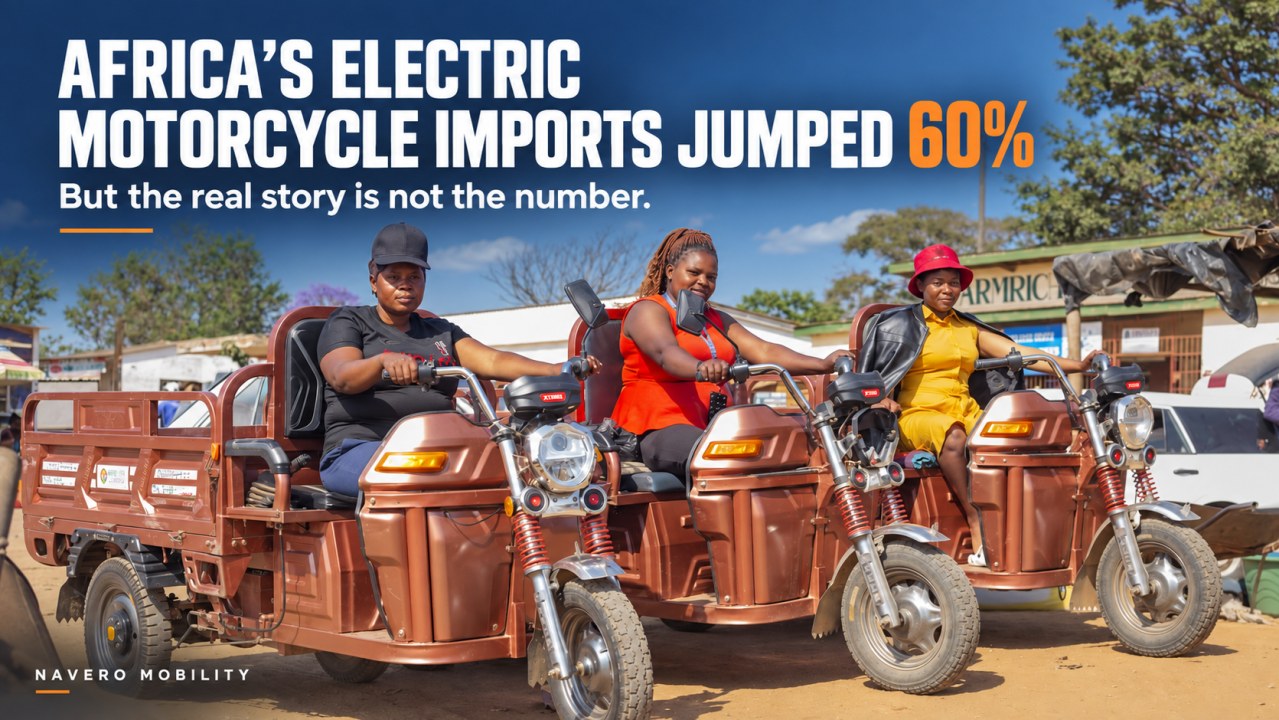
Africa imported $114.6 million worth of electric motorcycles and three-wheelers from China in the first half of 2026, a 60% increase from the same period last year.
The easy conclusion is that Africa’s electric two-wheeler market is booming.
But the number hides a more important reality:
Africa is not one electric mobility market.
One Continent, Different Market Patterns
In North Africa, Morocco imported more than 80,000 electric motorcycles and three-wheelers during the period, becoming the continent's largest destination by volume.
Much of this demand is driven by consumer mobility: electric scooters and mopeds used for commuting and short urban trips. Here, competitively priced CBU vehicles, or completely built units, can enter the market relatively quickly through established importers and dealer networks.
In parts of East and West Africa, however, the market is developing differently.
Electric motorcycles are increasingly being used for moto-taxi and delivery services. Riders may travel more than 100 kilometres every day, which makes uptime, charging speed and operating cost more important than screens, styling or entertainment features.
These markets often need more than a vehicle. They need:
- Battery-swapping or reliable charging networks
- Rider financing
- Local assembly
- Readily available spare parts
- Trained service partners
- Durable vehicles designed for intensive commercial use
The Same Vehicle Will Not Work Everywhere
A private commuter and a commercial rider are not buying the same solution.
One may prioritize price, appearance and convenient home charging. The other depends on the vehicle to earn a living and cannot afford several hours of downtime.
That means importers and manufacturers must ask more specific questions:
- Who will use the vehicle?
- How far will it travel each day?
- What loads and road conditions will it face?
- Will users charge at home or exchange batteries?
- Should the vehicle arrive as CBU, SKD or CKD?
- Who will provide maintenance and spare parts?
SKD, or semi-knocked-down, and CKD, or completely knocked-down, assembly can support localization, but only when the local technical and supply-chain capabilities are ready.
Import Growth Is Not the Same as Market Maturity
There is also an important limitation behind the headline.
The reported figures come from Chinese customs data. They show what was exported, not how many vehicles were registered, sold to final users or successfully kept in operation.
Rapid import growth can be a strong market signal, but it can also create excess inventory if products, infrastructure and local demand are not properly matched.
The Real Opportunity
Africa’s electric mobility transition will not be won by shipping the same low-cost model to every country.
It will be won by companies that understand the local use case and adapt the vehicle, battery system, assembly model and after-sales network accordingly.
At NAVERO MOBILITY, we believe export strategy should begin with how a vehicle will be used locally, not simply with which model is easiest to ship.
Because the right vehicle is only one part of the solution.
The right market-entry model matters just as much.
Sources: Associated Press reporting on Africa’s electric motorcycle and three-wheeler imports, and the United Nations Environment Programme continental electric mobility framework.
Originally published on LinkedIn: Africa’s Electric Motorcycle Imports Jumped 60% - But the Real Story Is Not the Number
Cover image: Courtesy of Mobility for Africa, via Good News Network. Graphic treatment and title overlay by NAVERO MOBILITY.
