
When governments announce electric vehicle policies, the conversation usually begins with cars.
Purchase subsidies. Charging stations. Tax reductions. New passenger-vehicle factories.
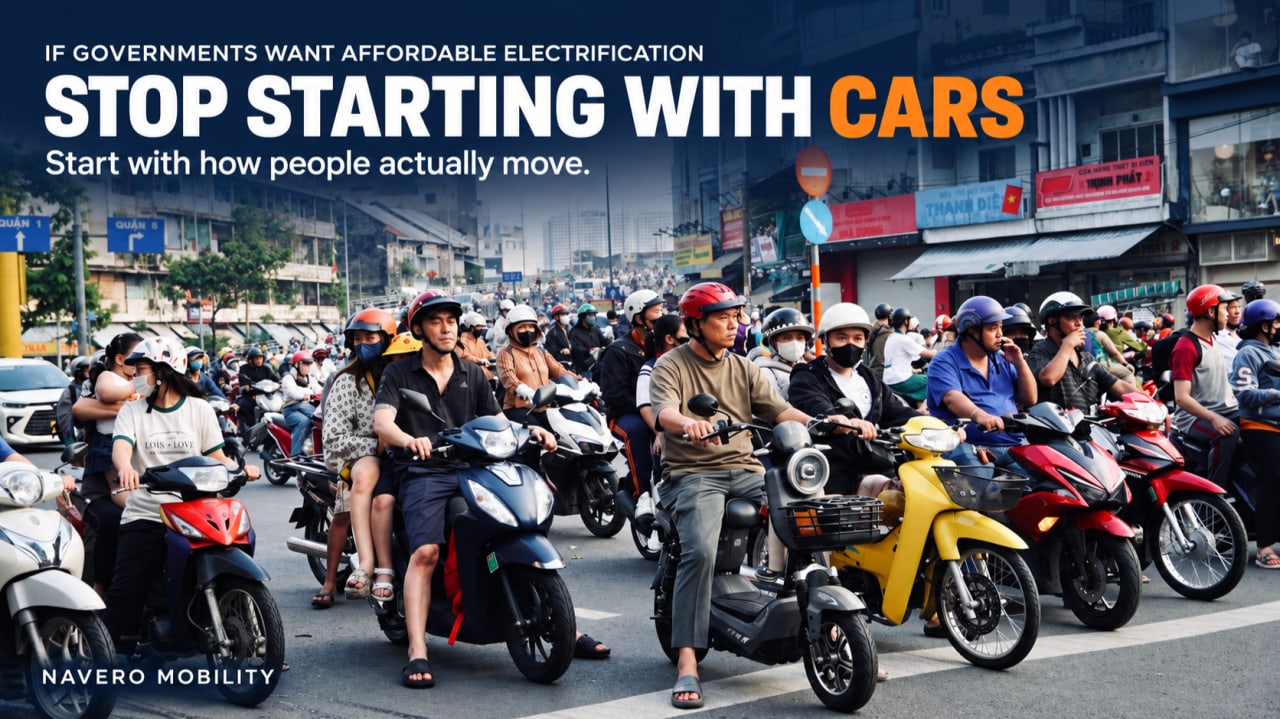
But in many emerging markets, cars are not how most people move.
Motorcycles, scooters, three-wheelers, minibuses and buses carry millions of people to work, transport goods and support small businesses every day.
So why are they so often treated as a secondary part of the electric transition?
Public Money Should Deliver Public Value
A recent analysis by the International Institute for Sustainable Development found that at least seven BRICS+ economies - including Brazil, China, Ethiopia, India, Indonesia, Malaysia and Thailand - are directing electric mobility support toward two- and three-wheelers, public transport and shared mobility.
The reasoning is straightforward.
Subsidizing an expensive private electric car may benefit one relatively wealthy household. Supporting an electric motorcycle, commercial three-wheeler or bus can improve mobility and reduce operating costs for workers, small businesses and entire communities.
This is not an argument against electric cars.
It is an argument for asking a more important question:
Which vehicles can deliver the greatest public benefit for every dollar of support?
The Numbers Tell a Different Story
India sold more than 21 million two-wheelers in the 2025/2026 fiscal year - approximately five times its passenger-car sales.
With sustained policy support, electric two-wheelers increased from around 0.4% of Indian two-wheeler sales in the first half of 2021 to a record 11% by July 2026.
Globally, around 570 million two- and three-wheelers are already operating across Africa, Asia and Latin America. Another 60 to 70 million are added every year, yet only about 15% of the global fleet is currently electric.
For governments seeking rapid and affordable electrification, this may be one of the largest opportunities hiding in plain sight.
Electrification Is Also an Economic Policy
Around 84% of the BRICS+ population lives in economies that are net importers of oil.
Electrifying frequently used motorcycles, three-wheelers and public transport can therefore do more than reduce emissions. It can also:
- Reduce exposure to volatile fuel prices
- Lower operating costs for commercial drivers
- Improve urban air quality
- Support local assembly and technical employment
- Make mobility more affordable for lower-income users
A commercial motorcycle or three-wheeler may travel far more kilometres each day than a privately owned car. Electrifying it can therefore displace more fuel - and generate more economic value - per vehicle.
Incentives Alone Are Not Enough
Redirecting support does not simply mean offering purchase subsidies.
Successful policies must also address the barriers that determine whether vehicles can operate reliably:
- Affordable financing
- Accessible charging or battery swapping
- Clear vehicle classifications and safety standards
- Reliable spare-parts and maintenance networks
- Training for technicians and assembly workers
- Predictable long-term regulation
Without these foundations, subsidies can increase vehicle sales without creating a sustainable market.
Start with How People Actually Move
The electric transition should not be designed around the most visible vehicle category. It should be designed around the vehicles people depend on most.
In some markets, that means buses.
In others, it means motorcycles used for commuting and delivery, or three-wheelers carrying passengers, crops and commercial goods.
At NAVERO MOBILITY, we believe affordable electrification begins with understanding real local mobility needs - and then matching the vehicle, battery, assembly model and after-sales system to those needs.
Because the most successful electric vehicle policy may not be the one that puts the most electric cars on the road.
It may be the one that makes electric mobility useful to the most people.
Sources: International Institute for Sustainable Development - EV Support for Public Transport and Two-Wheelers and the United Nations Environment Programme - Global Electric Two- and Three-Wheeler Conference 2026.
Originally published on LinkedIn: If Governments Want Affordable Electrification, They Should Stop Starting with Cars
Cover photo by Tuan Vy via Pexels. Graphic treatment and title overlay by NAVERO MOBILITY.
