
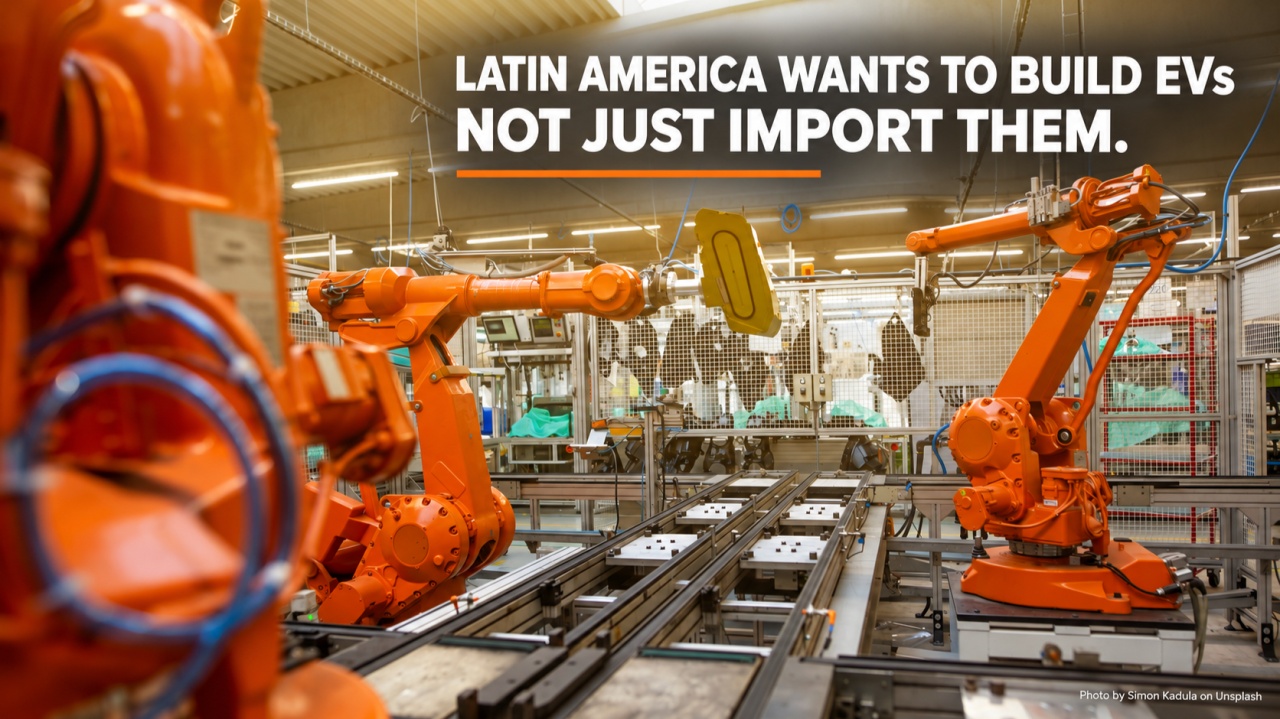
For years, the electric mobility opportunity in Latin America has been discussed mainly as an import opportunity.
Manufacturers produce the vehicles. Importers bring them into the market. Distributors sell them. Local workshops provide maintenance.
Mexico’s new Olinia Carga project suggests that this model may be beginning to change.
The electric cargo minivehicle is designed to carry up to 650 kilograms, travel more than 120 kilometres per charge and recharge from a conventional electrical outlet. Its announced operating cost is one-third that of a traditional motocarro.
But the most important part of the project may not be the vehicle itself.
Mexico does not only want to use electric vehicles. It wants more of their economic value to be created locally.
From Product Launch to Industrial Policy
The Mexican government plans to bring private industrial partners into the production of Olinia.
Registration for interested manufacturing partners is scheduled for October 2026, with formal proposals and investment decisions expected before the end of the year. The goal is to begin selling the vehicle in late 2027 at a price of approximately MXN 150,000.
The project says that 8,000 of its planned first-year production of 10,000 units are already committed, with a longer-term ambition to reach annual capacity of 50,000 vehicles.
These are still targets rather than completed production results.
Nevertheless, they send a clear signal: electric mobility is increasingly being treated not only as a transport or environmental policy, but also as an industrial-development strategy.
“Local Manufacturing” Is Not One Thing
A vehicle described as locally manufactured may still depend on imported:
- Battery cells
- Motors and controllers
- Power electronics
- Electronic components
- Software and diagnostic systems
- Specialized production equipment
Local value can be created gradually through vehicle assembly, frames, body panels, seats, wiring, cargo boxes, battery-pack integration, software adaptation, testing and after-sales service.
This means the real question is not simply:
“Was the vehicle imported or made locally?”
A better question is:
“Which parts of the vehicle and its supply chain can be localized competitively, safely and at sufficient scale?”
The Three-Wheeler Industry Should Pay Attention
Olinia Carga is not a three-wheeler. However, it is designed for many of the same applications currently served by motocarros and light cargo tricycles:
- Neighbourhood deliveries
- Small-business logistics
- Market transportation
- Municipal services
- Short urban routes
- Informal and semi-formal commercial transport
If locally backed electric minivehicles become available at competitive prices, imported electric three-wheelers will no longer be competing only with petrol-powered motocarros.
They may also compete with locally assembled or nationally supported electric platforms.
For three-wheeler manufacturers, this creates both a challenge and an opportunity.
Exporting the Vehicle May No Longer Be Enough
In an early-stage market, exporting CBU—completely built units—is often the fastest way to test demand.
As volumes grow, however, governments, investors and distributors may ask for more:
- SKD—semi-knocked-down assembly
- CKD—completely knocked-down assembly
- Local sourcing of frames, seats and cargo bodies
- Training for assembly and service technicians
- Technical documentation and diagnostic support
- Adaptation to local roads, climate and regulations
- A credible plan for increasing local value over time
The manufacturer’s role therefore begins to change.
It is no longer only a vehicle supplier. It may need to become a platform, engineering and supply-chain partner.
Localization Must Be Practical
Local manufacturing should not become a slogan.
Forcing too much localization before suppliers, volumes and technical capabilities are ready can increase costs and reduce quality. Building every component domestically is not automatically more efficient or more sustainable.
A better approach is phased localization:
- Begin with reliable imported vehicles or assembly kits.
- Establish demand, service and spare-parts systems.
- Localize suitable metal, body and interior components.
- Develop local battery-pack integration and testing.
- Increase local engineering and supplier participation as volume grows.
This allows a market to create jobs and technical capability without asking customers to finance an immature supply chain.
A New Kind of Partnership
The future of Latin American electric mobility may not be purely imported or entirely local.
It may be built through partnerships that combine global component and manufacturing experience with local assembly, market knowledge, service networks and investment.
At NAVERO MOBILITY, we believe manufacturers entering Latin America must be prepared to offer more than finished vehicles.
They must be ready to support different stages of market development—from CBU imports to SKD and CKD assembly, product customization and local supply-chain cooperation.
Because Latin America may still import many electric vehicles in the years ahead.
But increasingly, it will also ask what value remains after the vehicle arrives.
Sources: Mexican government announcement on Olinia Carga, Olinia project interview published by El País, and the October 2026 Mexican government update on the project.
Originally published on LinkedIn: Latin America Does Not Just Want Electric Vehicles. It Wants to Build Them.
Photo by Simon Kadula on Unsplash
